
Contents
Launching a new tech product is often risky. Launching the one that combines AI-generated videos, storytelling, and interactive video features, while the whole tech world is watching, is even harder.
This was the challenge our client faced when developing a streaming service focused on interactive AI shows. Such an idea drew attention from media like Forbes and TechCrunch, so expectations were high, and launch day had no room for mistakes.
Yet, great ideas need more than creativity to succeed. Such ideas need a strong, reliable technical backbone. This is the story of how we at IT Outposts developed infrastructure that helped our client launch with confidence and keep growing.
Meet the Visionaries Behind the Platform for AI Entertaining
The project is led by a former Google executive and a documentary filmmaker. Thus, the founders bring together a strong tech background and professional storytelling expertise.
They decided to create a streaming platform of a new kind—a place where creators can publish their AI work and viewers can discover and watch this content, as well as explore different story paths and change the direction of the story.
The Reality Check: What Was Holding the Platform Back
When we joined the project, our client already had an initial cloud setup, and it evolved at a fast pace. Yet, not as quickly as the vision demanded.
The infrastructure was still fragile since core DevOps processes were missing, and the system wasn’t ready for the attention that launch day would bring.
Here’s what our client was working with when we stepped in.
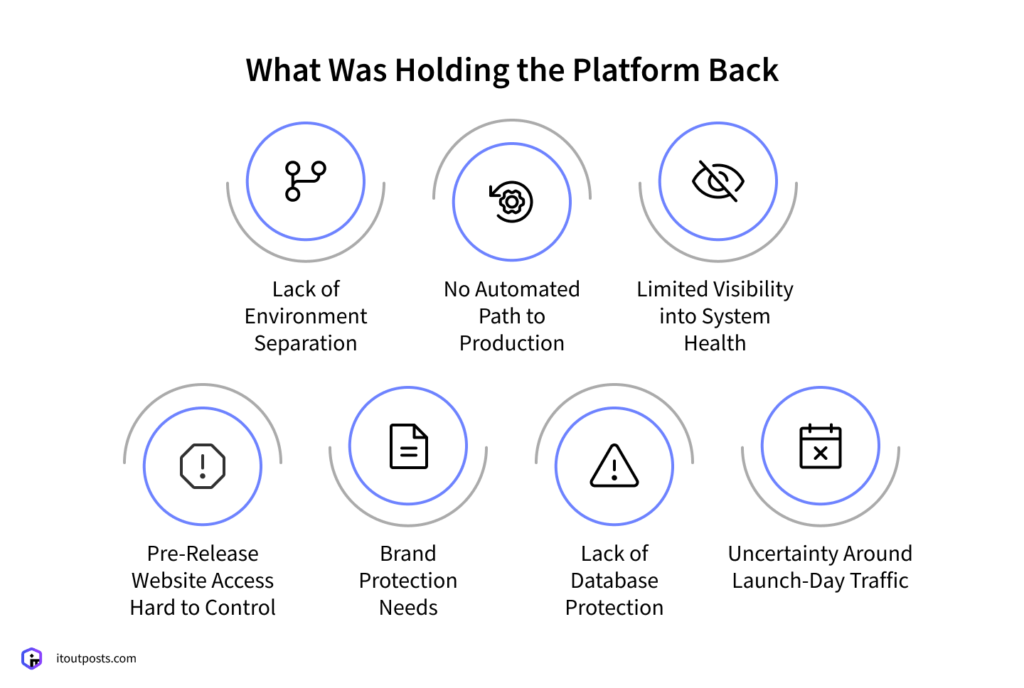
Lack of Environment Separation
The development process relied only on the main branch. While team members occasionally created separate feature branches, all changes were pushed straight into the main one. The more complex the platform became, the harder it was for team members to collaborate and prevent any errors from getting into production.
No Automated Path to Production
Also, there was no CI/CD pipeline in place. Thus, releases had to be managed manually, which meant slower development cycles and, again, more room for errors in production. And as new features were added regularly, manual processes were clearly not a sustainable way to move forward.
Limited Visibility into System Health
The platform had no proper monitoring or alerting. The team couldn’t see how the system was behaving in real time and detect any critical problems that could affect users.
This meant the troubleshooting process was reactive. Yet, proactivity is a must when you don’t want users to be the first to notice any mistakes. Some users may point out to them, while others may just quietly leave.
Pre-Release Website Access Hard to Control
Our client needed the platform to be available on the internet for testing, but only open to the internal team before launch. Existing access control options didn’t make it possible to simulate all real user scenarios as closely as possible.
Brand Protection Needs
Upcoming public attention meant responsibility to protect the brand. There was a concern that the platform may attract not only our client’s target audience but also bad actors. Similar domain names could be created and used to mislead users and steal their information or damage the brand’s reputation.
Lack of Database Protection
The database required protection, too. It stores critical information, from user data to content details, which must be protected from unauthorized access. But at the same time, engineers still had to easily access the database to do their work. We needed to strike this balance of security and ease of access for the client’s team.
Uncertainty Around Launch-Day Traffic
The client’s team expected a spike in users on launch day. But at this point, there was no certainty that the infrastructure would stay stable under heavy load.
The Role of IT Outposts
During our first meetings, we wanted to fully understand the idea behind the product, how the platform was built, the pace at which the team was working, and the pressure they were under. Our client required clarity on what had to be fixed first, what could wait, and how to move forward without slowing development and creating new risks.
Our role was to help the team make the right technical decisions at the right time, prioritizing stability on the launch day, yet, making sure the infrastructure won’t become a limitation later on, but instead will support new ideas tomorrow.
The Plan: Starting with AMIX—a Ready-to-Use Infra Setup
Once both the technical and business challenges were clear, it was time to act.
Small fixes and temporary patches definitely weren’t an option, as our client needed a complete, reliable setup that could support the launch and grow with the platform over time.
To achieve this goal, we at IT Outposts used our turnkey solution: AMIX Infrastructure.
AMIX is a ready-to-use Kubernetes-based infrastructure setup designed to speed up time to market. It provides:
- A preconfigured cloud infrastructure built with DevOps best practices
- 20+ essential DevOps tools already selected and integrated
- A solid base that helps teams save engineering time and infrastructure costs
Importantly, ready-to-use doesn’t always mean rigid. We built AMIX in a way that wouldn’t limit our projects in any way later. Whenever we need to add any custom extras, we can freely add new elements on top.
Our team relied on AMIX when setting up the core components, including:
- Infrastructure as code to define and manage the entire setup in a clear, repeatable way, making changes easier to track and restore
- Kubernetes to make deployments more reliable and scaling easier as traffic grows
- Multiple environments to separate development, testing, and production, allowing the team to test changes safely before release
- Virtual private clouds (VPCs) to isolate and secure network resources, keeping internal services protected
- Secret management to store sensitive data like keys and credentials securely, without exposing them in code
By using AMIX at the beginning, we were able to save valuable engineering time and, thus, our client’s budget.
Adding Custom Pieces to the Foundation
Next, our team continued refining the foundation. Here’s what else we did.
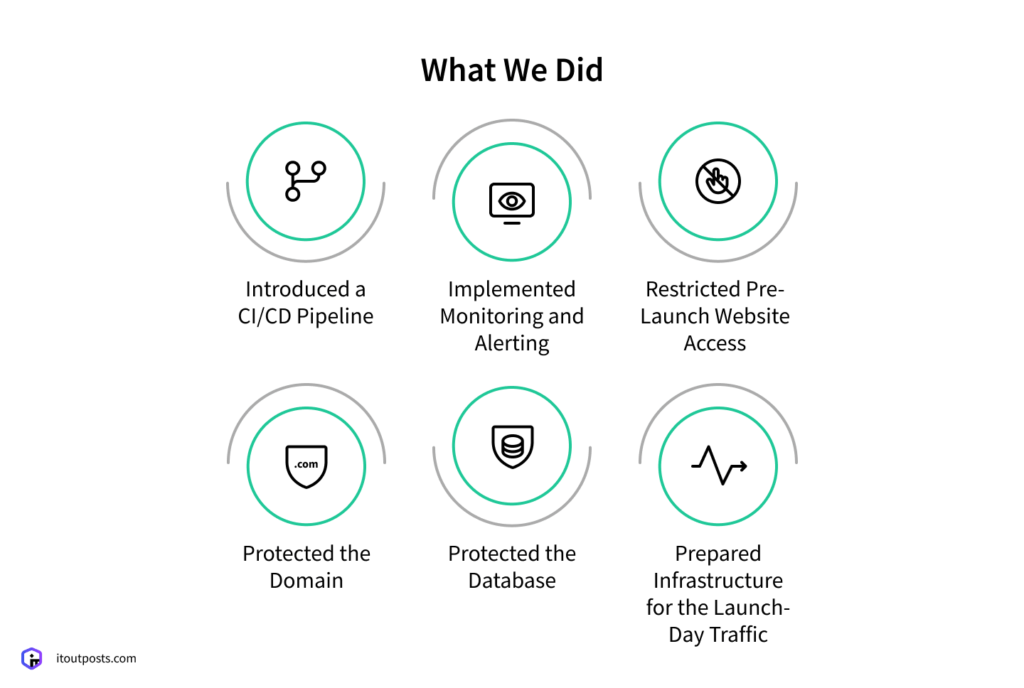
Introduced a CI/CD Pipeline
We set up AWS CodeBuild to handle the build stage and used AWS CodePipeline to manage the deployment flow. This ensured that updates could be safely released from development into production.
Implemented Monitoring and Alerting
Our team implemented monitoring using Amazon CloudWatch, which allowed us to track system health, performance, and key metrics across the platform.
We also made sure alerts were delivered automatically. By connecting the CI/CD pipeline with Amazon EventBridge, the client’s team started receiving notifications after every deployment. If a release went well, they get a success message. If something went wrong, they’re alerted immediately, too. We also connected these alerts to Slack using AWS Chatbot.
Restricted Pre-Launch Website Access
To create a convenient authentication system to hide the website from the public before launch, yet leave the platform open for the team, we used AWS CloudFront, a content delivery network service, together with a Lambda function.
Here’s how this system works: When someone tries to open the website for the first time, CloudFront triggers the authentication process via a Lambda function.
After a successful login, the system creates a token and saves it in the cache. This way, team members don’t need to log in repeatedly and can access all parts of the website while testing every user flow.
Protected the Domain
Our client thought through all key domain name variations and registered them to avoid any misuse.
We then ensured that all these domains redirected to one main website. To do this, we set up redirect logic so that anyone visiting an alternative domain was automatically sent to the official one. This was done with the help of Amazon S3 buckets.
Security was considered as well. Our team enabled secure, encrypted connections with SSL certificates.
Protected the Database
We placed the database inside a private network, where it isn’t exposed to the public internet and can’t be reached directly.
At the same time, the client’s development team still needed to access the database conveniently. To make this possible, we introduced bastion hosts to ensure a secure access path. So, now, whenever someone needs to connect to the database, they first go through these bastion hosts.
However, this database access method was new to our client’s team. But our goal is not only to configure infrastructure but also to make sure that our clients’ teams feel comfortable dealing with these new configurations. So we also provided training, walking our client’s team through how the bastion hosts work and how to use them in day-to-day tasks.
Prepared Infrastructure for the Launch-Day Traffic
One of the most important steps before launch was making sure the platform could handle real user traffic. To verify whether the platform is already ready, we conducted load testing. We put the system under stress by simulating a large number of users visiting the platform simultaneously.
These tests let us receive a clear picture of how the infrastructure behaved under pressure. We were able to clearly understand where the limits were and what needed to be improved. Based on the results, our team added more resources and adjusted the autoscaling settings so the system could automatically scale when demand increased.
We also planned for the unexpected. Our team created a contingency plan with the necessary steps to take in case traffic exceeded the system’s limits and the system didn’t scale quickly enough.
Launch Day
By the time launch day arrived, the pressure was at its peak, but the work done gave us and our client’s team confidence. Every critical part of the system had already been tested under pressure and adjusted based on results. Scaling was in place, too. When users started coming in, the platform did exactly what it was supposed to do, and dashboards showed healthy metrics across the platform.
Our client went live on schedule and welcomed its first users without any issues.
What’s Next: A Foundation for Bigger Stories
With a reliable infrastructure in place, our client can keep creating and innovating. The tech foundation doesn’t limit this but, in contrast, supports new ideas, experiments, and growth.
IT Outposts remains a long-term partner on this journey. We continue to support the platform as it grows, refine the infrastructure, and help prepare for any future challenges. There’s more ahead, and this is only the beginning of the story.
Ready to Create Your Own Launch Story?
The client’s launch was about both the idea and the right technology—technology that helped turn this idea into reality, and fast. AMIX played an important role in launching on schedule and became a real competitive advantage for the project. Importantly, stability was never sacrificed.
We provided our client with a ready starting point, making it easier to deploy updates, scale, and grow without having to rethink infra later.
If you’re planning a launch, facing growth challenges, or thinking about moving to Kubernetes, let’s talk. We’re here to help you build a foundation that’s ready for the spotlight today and for any ambitious ideas tomorrow!
Also, you can try AMIX for free yourself. Get it here by completing a short form and let us know what you think!

I am an IT professional with over 10 years of experience. My career trajectory is closely tied to strategic business development, sales expansion, and the structuring of marketing strategies.
Throughout my journey, I have successfully executed and applied numerous strategic approaches that have driven business growth and fortified competitive positions. An integral part of my experience lies in effective business process management, which, in turn, facilitated the adept coordination of cross-functional teams and the attainment of remarkable outcomes.
I take pride in my contributions to the IT sector’s advancement and look forward to exchanging experiences and ideas with professionals who share my passion for innovation and success.